



Kisspeptin 45-54 (Kisspeptin-10) and Neuronal Cells: Hypothalamic Signaling, Reproduction, and Neuroprotection
Kisspeptin 45-54 — better known as kisspeptin-10 (KP-10) — is a 10–amino-acid fragment of the KISS1 precursor that activates the KISS1 receptor (GPR54) with nanomolar affinity. This research-use-only review examines its four best-studied roles in cells: driving hypothalamic GnRH/reproductive signaling, modulating ovarian granulosa steroidogenesis, shaping appetite-related transcripts, and — through a receptor-independent route — protecting cholinergic neurons from amyloid-β and α-synuclein toxicity.
Research-use-only disclaimer: Kisspeptin 45-54 is intended strictly for in-vitro and laboratory research use. It is not a drug, supplement, or therapy, and it is not intended for human or veterinary use. Every finding below is drawn from cell-culture or animal models and is described in hedged, mechanistic terms. Nothing here is medical advice.

TL;DR
Kisspeptin 45-54 (kisspeptin-10, sequence YNWNSFGLRF-NH2) activates the KISS1 receptor (GPR54) at ~1.6–2.3 nM affinity via Gq/Ca2+ signaling. In research models it probes hypothalamic GnRH release, raises granulosa-cell progesterone (via StAR / miR-1246), and shifts appetite transcripts. Notably, it also protects cholinergic neurons from amyloid-β and α-synuclein toxicity through a GPR54-independent mechanism. Research use only.
Identity: 10-aa KISS1 fragment (residues 45–54); retains full-length-like activity at GPR54.
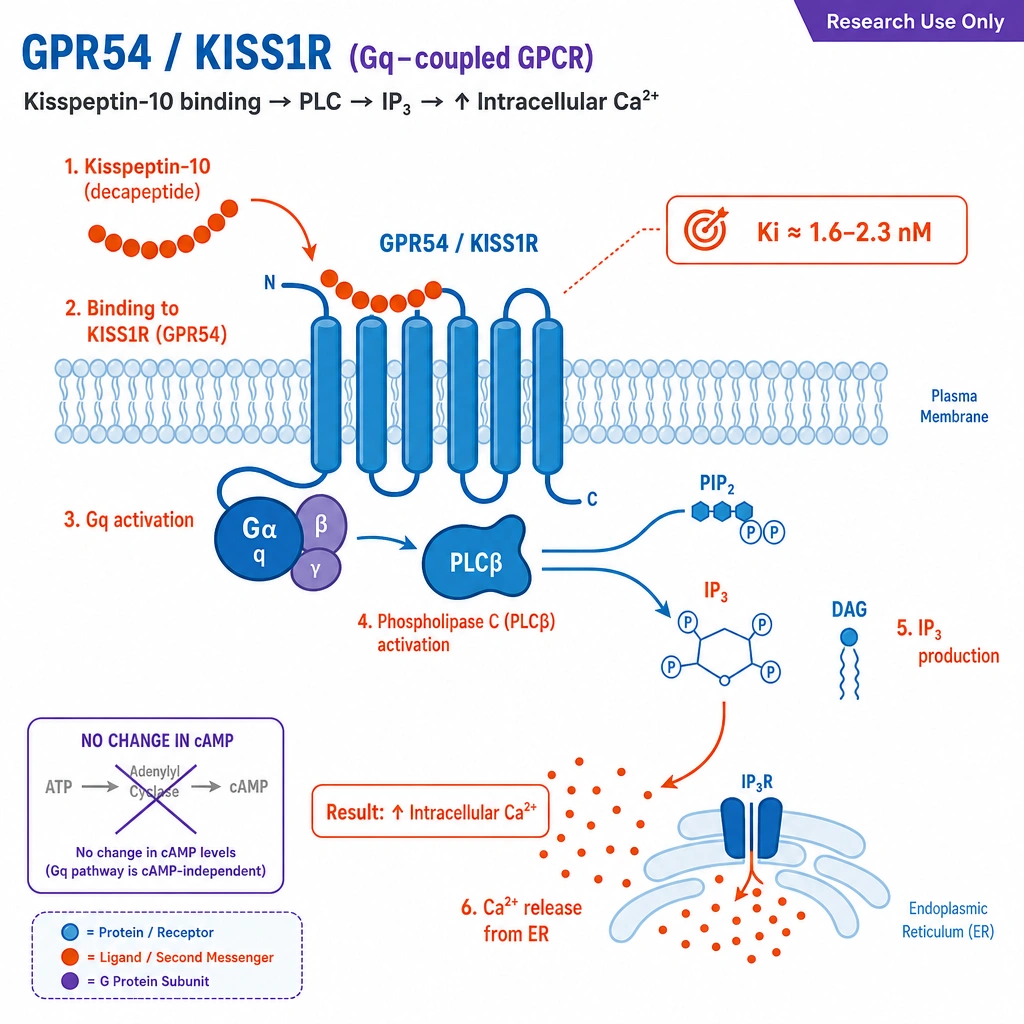
Receptor: GPR54/KISS1R, Gq-coupled; Ki ~1.59 nM (rat) / 2.33 nM (human); Ca2+ mobilization without cAMP change.
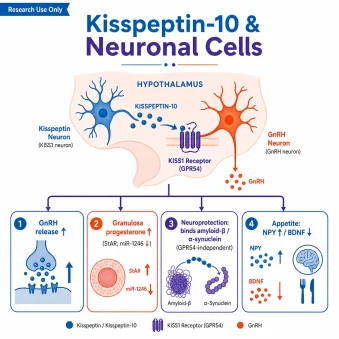
Reproduction: raises Kiss-1/GnRH transcripts and c-Fos; concentration-dependent GnRH release; granulosa progesterone up via StAR and miR-1246 downregulation.
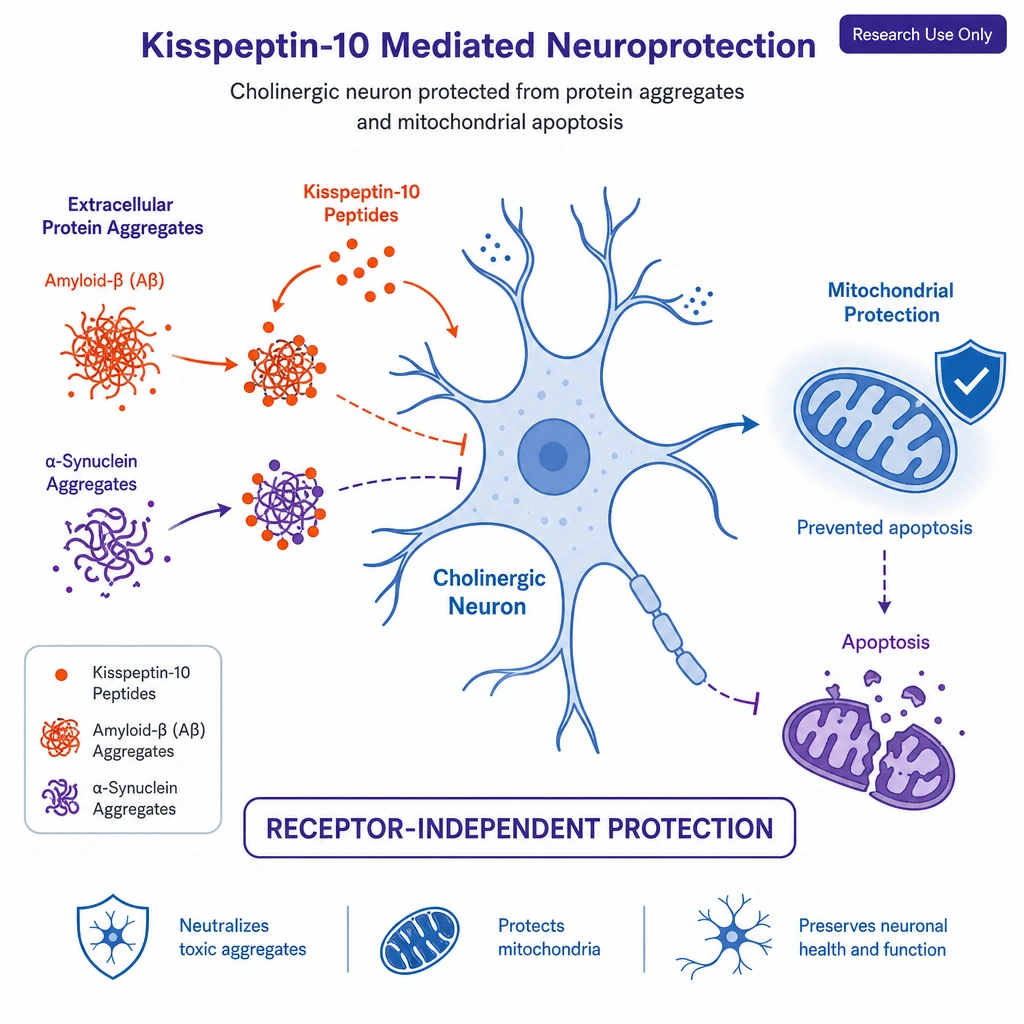
Neuroprotection: binds Aβ/PrP/IAPP and reduces toxicity; rescues cholinergic cells from α-synuclein — GPR54-independent, at ~0.1 µM.
Appetite: NPY up, BDNF down, dopamine/serotonin down in Hypo-E22 — an orexigenic-type profile in that model.
What Is Kisspeptin 45-54, and What Receptor Does It Hit?
Kisspeptin 45-54 is a synthetic 10-amino-acid peptide with the sequence Tyr-Asn-Trp-Asn-Ser-Phe-Gly-Leu-Arg-Phe-NH2, corresponding to residues 45–54 of the KISS1 precursor. Despite being much shorter than the full-length precursor, it retains comparable intrinsic bioactivity at the KISS1 receptor — a point established in the founding work by Kotani et al. (2001), which identified kisspeptins as the natural ligands of the orphan receptor GPR54.
That receptor profile is why kisspeptin-10 is such a versatile probe: a single, well-defined Gq/Ca2+ input can be read out across very different cell types, from hypothalamic neurons to ovarian granulosa cells.
How Does Kisspeptin 45-54 Act on Hypothalamic Neurons?
Research by Kanasaki et al. (2021) on immortalized hypothalamic neurons shows that kisspeptin 45-54 engages different transcriptional programs depending on the cell model. They compared two lines: mHypoA-50, derived from the anteroventral periventricular nucleus (AVPV), and mHypoA-55, derived from the arcuate nucleus (ARC). Both express endogenous Kiss-1 and GnRH transcripts and their receptors.
The responses diverged by nucleus. In mHypoA-50 (AVPV) cells, kisspeptin exposure raised Kiss-1 mRNA and kisspeptin protein while GnRH transcript stayed largely unchanged. In mHypoA-55 (ARC) cells, both Kiss-1 and GnRH mRNA rose together — suggesting nucleus-specific wiring shapes the downstream transcriptional response. In both lines, c-Fos protein rose after stimulation, a standard surrogate marker of neuronal activation. Because hypothalamic cells regulate many other neurons and endocrine cells, the authors framed kisspeptin and GnRH as "central regulators of the hypothalamic-pituitary-gonadal axis" at the cellular level.
How Does Kisspeptin 45-54 Drive the GnRH / Gonadotropic Axis?
Building on the transcriptional data, the peptide's downstream job is to modulate GnRH-producing neurons. Garcia et al. (2019) reported that kisspeptin 45-54 elicits GnRH release in a concentration-responsive fashion, with the magnitude shifting according to the maturation level of the model. Within this framework, kisspeptin-10 serves as a probe for how kisspeptin and neurokinin-B (NKB) neurons reciprocally modulate one another — the core "KNDy" circuitry that paces the reproductive axis.
What Are Its Effects on Ovarian Granulosa Cells?
Kisspeptin-10's reach extends outside the brain. Guo et al. (2022) examined bovine granulosa cells (BGCs), focusing on progesterone (P4) biosynthesis and the microRNA miR-1246.
This peripheral action illustrates that kisspeptin signaling is not confined to central GnRH control — it can directly influence ovarian steroidogenic pathways in cultured cells.
How Does Kisspeptin 45-54 Interact with Amyloid-β and α-Synuclein?
A distinct line of work suggests kisspeptin-10 can bind misfolded, amyloidogenic peptides extracellularly and blunt their toxicity. Milton et al. (2012) reported that kisspeptin peptides bind amyloid-β (Aβ) and reduce its in-vitro toxicity, "[mitigating] the neurotoxicity of Aβ, PrP, and IAPP peptides, via an action that [may] not be blocked by kisspeptin-receptor (GPR-54) or neuropeptide FF (NPFF) receptor antagonists" — pointing to a direct peptide–peptide interaction rather than classical receptor signaling.
Given the structural overlap between the non-amyloid-β component (NAC) of α-synuclein (α-syn) and the C-terminus of Aβ, Simon et al. (2022) extended this to α-syn in cholinergic-differentiated SH-SY5Y cells.
A follow-up by Simon et al. (2023) in ChAT-positive SH-SY5Y neurons reinforced that KP-10 may reduce α-syn-associated apoptosis and mitochondrial depolarization independently of KISS1R, and lowered α-syn and choline acetyltransferase (ChAT) immunoreactivity — hinting at engagement of intracellular aggregate-handling pathways. This has been framed in the context of dementia with Lewy bodies, where Aβ and α-syn co-accumulate in cholinergic neurons.
Does Kisspeptin-10 Affect Appetite Signaling?
Finally, Orlando et al. (2018) probed metabolic and orexigenic correlates in the Hypo-E22 hypothalamic cell line, tracking neuropeptide Y (NPY), BDNF, and monoamine turnover. Hypo-E22 cells tolerated the peptide; NPY gene expression rose while BDNF fell, and dopamine (DA) and serotonin (5-HT) content decreased (with increased DOPAC/DA and 5-HIAA/5-HT turnover ratios), while norepinephrine was largely unchanged. The authors read elevated NPY alongside reduced BDNF and 5-HT as a potentially orexigenic profile — though strictly within that in-vitro paradigm.
| Context | Model | Key reported finding |
|---|---|---|
| Receptor binding | KISS1R/GPR54 | Ki ~1.59 nM (rat) / 2.33 nM (human); Gq/Ca2+ |
| Hypothalamic | mHypoA-50 / mHypoA-55 | Kiss-1/GnRH mRNA & c-Fos shifts (nucleus-specific) |
| Reproductive | GnRH models | Concentration-dependent GnRH release |
| Ovarian | Bovine granulosa cells | ↑ P4, ↑ StAR, ↓ miR-1246 |
| Neuroprotection | Cholinergic SH-SY5Y | Rescues Aβ/α-syn toxicity (GPR54-independent) |
| Appetite | Hypo-E22 | ↑ NPY, ↓ BDNF, ↓ DA/5-HT |
How is research-grade kisspeptin 45-54 characterized?
Because the C-terminal amide (–Phe-NH2) is essential for KISS1R activity, identity and purity verification are especially important. Research-grade kisspeptin-10 is typically confirmed by reversed-phase HPLC for purity and mass spectrometry for identity (including amidation), handled cold, and supplied for laboratory use only. At PrymaLab, research peptides are characterized with HPLC/MS verification and independent third-party testing. No specific lot data are asserted in this general reference.
Frequently Asked Questions
What is kisspeptin 45-54?
It is a synthetic 10-amino-acid peptide (kisspeptin-10, YNWNSFGLRF-NH2) corresponding to residues 45–54 of the KISS1 precursor. It retains full-length-like activity at GPR54 and is for research use only.
What receptor does kisspeptin-10 activate?
The KISS1 receptor (GPR54), a Gq-coupled GPCR, with Ki ~1.59 nM (rat)/2.33 nM (human). Activation mobilizes intracellular calcium without changing cAMP.
How does it affect reproduction?
It raises Kiss-1/GnRH transcripts and c-Fos in hypothalamic cells and triggers concentration-dependent GnRH release; in granulosa cells it raises progesterone via StAR and miR-1246 downregulation.
Can it protect neurons from amyloid or α-synuclein?
In research models, yes, via a GPR54-independent route. KP-10 (0.1 µM) suppressed wild-type and E46K α-synuclein apoptosis and mitochondrial depolarization even with the GPR54 antagonist KP-234 present (Simon et al.).
Does it affect appetite signaling?
In Hypo-E22 cells, Orlando et al. reported higher NPY, lower BDNF, and reduced dopamine/serotonin — an orexigenic-type profile in that model.
Is kisspeptin 45-54 approved for human use?
No. It is a research-use-only peptide studied in cell lines and animal models, not an approved drug, and not for human or veterinary use.
References
- Kotani M, Detheux M, Vandenbogaerde A, et al. The metastasis suppressor gene KiSS-1 encodes kisspeptins, the natural ligands of the orphan G protein-coupled receptor GPR54. J Biol Chem. 2001;276(37):34631–34636. PMID:11457843
- Kanasaki H, Tumurbaatar T, Tumurgan Z, et al. Mutual Interactions Between GnRH and Kisspeptin in GnRH- and Kiss-1-Expressing Immortalized Hypothalamic Cell Models. Reprod Sci. 2021;28(12):3380–3389. PMID:34268716
- Garcia JP, Keen KL, Seminara SB, Terasawa E. Role of Kisspeptin and NKB in Puberty in Nonhuman Primates: Sex Differences. Semin Reprod Med. 2019;37(2):47–55. PMID:31847024
- Guo L, Xu H, Li Y, et al. Kisspeptin-10 Promotes Progesterone Synthesis in Bovine Ovarian Granulosa Cells via Downregulation of microRNA-1246. Genes (Basel). 2022;13(2):298. PMID:35205342
- Milton NGN, Chilumuri A, Rocha-Ferreira E, et al. Kisspeptin prevention of amyloid-β peptide neurotoxicity in vitro. ACS Chem Neurosci. 2012;3(9):706–719. PMC3447396
- Simon C, Soga T, Ahemad N, et al. Kisspeptin-10 Rescues Cholinergic Differentiated SHSY-5Y Cells from α-Synuclein-Induced Toxicity In Vitro. Int J Mol Sci. 2022;23(9):5193. PMC9105316
- Simon C, Soga T, Parhar I. Kisspeptin-10 Mitigates α-Synuclein-Mediated Mitochondrial Apoptosis in SH-SY5Y-Derived Neurons via a Kisspeptin Receptor-Independent Manner. Int J Mol Sci. 2023;24(7):6056. PMC10094180
- Orlando G, Leone S, Ferrante C, et al. Effects of Kisspeptin-10 on Hypothalamic Neuropeptides and Neurotransmitters Involved in Appetite Control. Molecules. 2018;23(12):3071. doi:10.3390/molecules23123071
Final disclaimer: This article is an educational research reference. Kisspeptin 45-54 is sold and studied for laboratory research use only, is not approved by any regulatory authority, and is not intended for human or veterinary use. Statements about kisspeptin 45-54 have not been evaluated by the FDA. Nothing here should be interpreted as medical advice.
Mechanistic descriptions are observations from cell lines and animal models that may not generalize. Always verify the legal status of any research compound in your jurisdiction before purchase or use.